21 February 2012

I never thought I’d miss snow, but in many ways I do. In general, I hate the stuff. And the idea of doing something ludicrous like hurling myself down steep and slippery snow-covered slopes with my feet strapped to bits of fibreglass is completely inconceivable. But now that ours is mostly melted, and we can use the car again, and our phone line has (finally) been restored, I’m missing my silent, clean, dazzling world.

My feeling of loss is partly aesthetic. Hard edges had been done away with, and – because I was here all alone and was happier crunching through powder than, for instance, digging paths which instantly became icy traps – everything remained all-but-pristine: after all, there weren’t many places I was all that keen to get to when everything had 70 centimetres of snow on top of it. When L came back, aching to ‘sort things out’ in an effort to stave off impending cabin fever, the situation changed.

Of course, by that time the thaw had set in gently. But beside his paths appeared angular piles of soiled, sad snow. And what had been my beautiful narrow path of footsteps – very deep at first then daily getting a little shallower as the thaw set in – in the otherwise virgin wastes between  our front gate and Mario’s house was destroyed as snow and ice were heaved and hauled out of the way in attempts (finally successful on Sunday evening) to get the car out.

But the loss is also of lifestyle. My daily tramps up to town were doing me such a lot of good. I was feeling so fit, with admirable thigh muscles. But I was also stopping to chat, socialising with snow-obsessed people all the way along my route, becoming an habituée in the convivial post office sorting room beyond which our mail would never have travelled had I not gone in to pick it up (ours, plus practically anyone else’s I chose to take – they weren’t being very fussy). Then there were the people passing through the Caffè degli Artisti where I set up my office for a couple of hours each day – just long enough to check and answer emails. It was all extremely jolly. And I’m missing it already.

The phone line drama was a less tranquil element in my world of snowy calm. From 2 February until 20 February: that’s a long time to be cut off from the world. Endless bootless conversations with the Telecom call centre, endless promises of immediate action – or rather action by ‘midnight on…’ – endless incompetence. At one point I was brushed off with a story of an enormous fault in the CdP central switchboard. Rubbish: the problem was, as always, severed lines down in the valley. Yesterday morning, my final brush with the Telecom Italia switchboard ended with the woman at the other end, having heard my sorry tale, saying “signora, you need a lawyer.” Not encouraging.

But then a technician called, I rushed out to intercept him, and when I saw him looking askance down into the valley where the phone line lies in its tangled mess on the ground, off I set, in true-Brit pioneer style, yelling “let’s get this thing sorted.” He would have looked like a wuss if he’d stayed behind. We clambered and scrambled down there, where bent and fallen trees and saplings had pulled the wires into all kinds of unlikely combinations: it was a miracle that only ours had gone, and not Mario’s and our Canadian neighbours’ too. Ours was severed in two places, one – inexplicably – snapped off cleanly at a point where there was nothing to fall and break it. “It looks like someone has cut it with a knife,” I said. “That’s what I was thinking,” said the tecnico. A mystery.

We patched it up with tape and extra bits of wire and hey presto, contact. But I felt sorry for the poor boy, despatched by himself to do a job which was simple with an assistant but completely impossible alone, by a company which is going bankrupt because Telecom is so slow to pay monies owed, and which hadn’t paid him for three months. That’s not the way to run a public service.

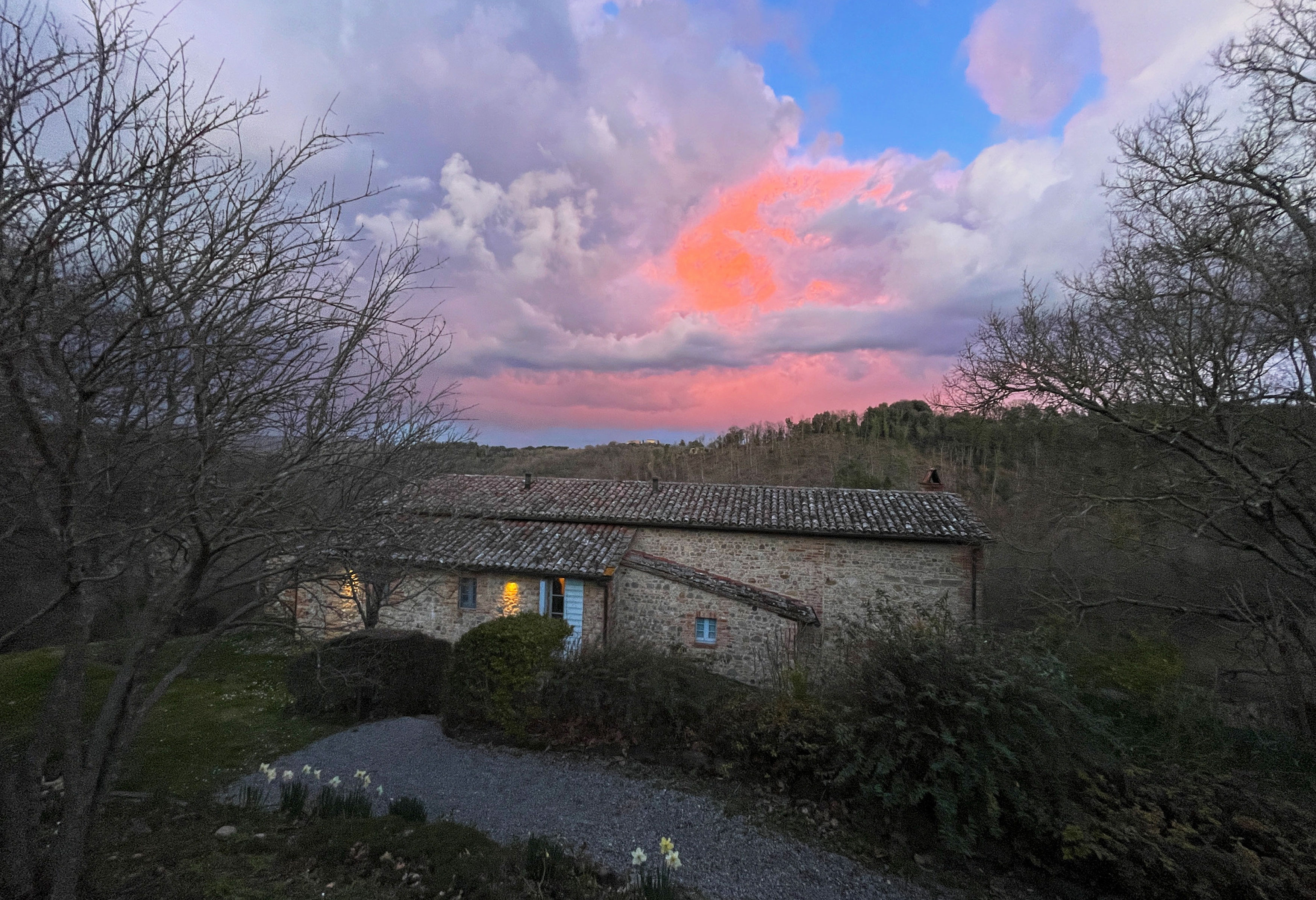
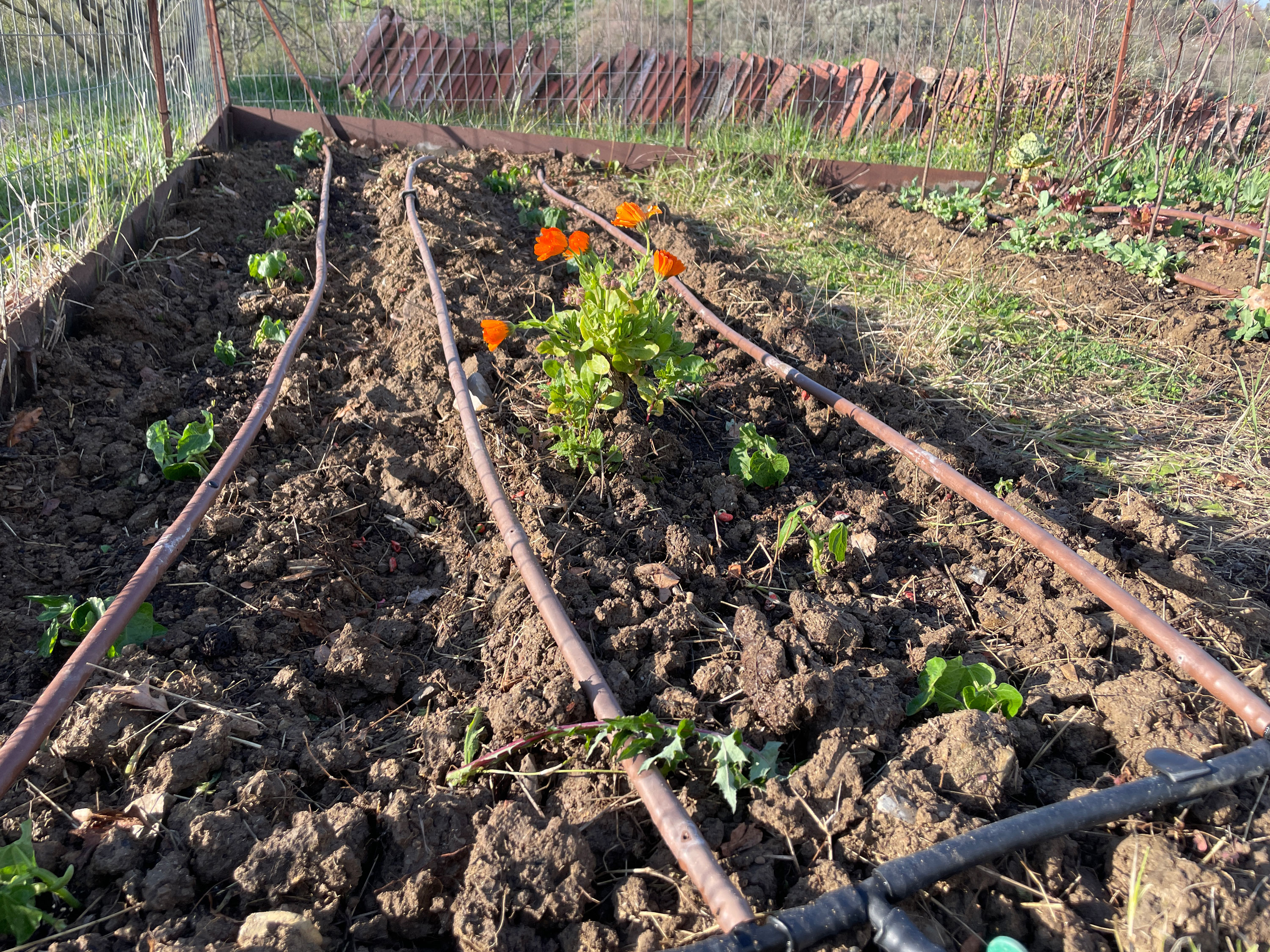
What has emerged from beneath almost a metre of snow, and after ten days of sub-zero temperatures, is heart-warming, as always. When I dug down 50 centimetres to the bed where my broad beans had been, there they were, beneath their thin covering of fleece, bigger than ever. Ditto the baby cabbage plants. Clearly the snow had insulated them, falling as it did before the really freezing weather arrived. My rosemary bushes, completely flattened beneath the weight, have sprung back and somehow look more freshly green than before. Even the poor battered old lavander plants by the chicken house are fine. The roses are covered with little buds and seem fairly unperturbed. The only thing which has suffered much, it seems, is the lovely field maple at the south end of the house – the one my washing line is strung from. Huge branches split and snapped from there, quite unexpectedly. It makes me think that maybe that tree isn’t really very well.

Most endearing, perhaps, is the parsley, popping out from beneath its shroud looking very chirpy indeed. I love plants. They just get on with it. Unlike so many people.

Posted in MUSINGS FROM UMBRIA | Leave a comment

10-11 February 2012

There was a journalist from Forlì talking on the radio just now about the maltempo (bad weather) there. She gave all the usual information, about cut-off villages and heroic rescue operations by Carabinieri officers braving miles on foot through deep snow to pull ill and ancient people out of isolated farmhouses.

Then she started reassuring listeners that the wolves were just an urban (or, in this case, rural) legend. She was doing it quite seriously, scotching the talk of cold and starving beasts stalking the deserted streets of country villages, or lying in wait just beyond the last straggling houses. You can see how these conditions might induce such thoughts. I spent the first four days of this week in Berlin – colder than I’d ever experienced in my life but mostly sunny and, of course, a city to explore. Had I been here in this howling white-and-grey world since February 2 when the first snow fell, the phone cut off as it has been since then, battling through drifts from time to time to get up to town – indeed today battling even to reach the chicken house to bring in more wood – I might have started imaging wolves too. Irrational fears don’t seem so improbable when you’ve been viewing the world for days through an unwonted lens, the colours all wrong and the survival strategies unfamiliar. The noises that reach you from a world of snow are all different. There’s almost a feeling of justification, peopling this strange world with fairy-tale bogeymen.

The couple of days before we went away, and yesterday afternoon when I returned, there wasn’t a cloud in the sky and the whole scene was quite magically glistening. Today it’s five below and the air is thick with snow, falling and drifting together, blown horizontal beneath a funereal sky. A wolf howl wouldn’t seem out of place. There are immense snow sculptures everywhere, climbing the wall of the house on the chicken house side, edging up in sharp, delicately wrought ridges to meet the snow piled on the roof of the stairs. Outside the front door I have to keep clearing a semi-circle for door-opening, otherwise there would be 60cm of snow banked against it and I would be reduced to clambering out of the big window at the southern end of the living room (that’s my emergency exit strategy; the shovel now lives just inside the front door, always at the ready). It all weighs on you, quite physically. Thankfully, it’s almost time to shut the shutters and pretend it isn’t happening. Not that I’ve opened many today: it gives me the impression (utterly self-deceptive, of course) of being warmer that way.

The other thing I noticed, listening to Italian radio which I do so infrequently, is how in the litany of snow-woes, the word ‘Umbria’ was never uttered. Every other afflicted region was named and studied in depth. Are things worse there? They didn’t sound so from the descriptions. I suppose it’s more unusual for Calabria to be stricken this way, though in fact the high Aspromonte is more prone to heavy snowfalls than we are. And of course snow in Rome is such a rarity that it always makes the news… even when, as earlier this afternoon, it is expected rather than really falling. Is snow in Umbria not a story because people imagine us somehow remote and chilly anyway? Or do they simply forget Umbria in their romps down the boot?  Either way, I’d say that if this keeps up tomorrow – and tomorrow is meant to be the toughest day of all – then we’ll have had well over a metre of snow. And that, in anybody’s book, is rather exceptional.

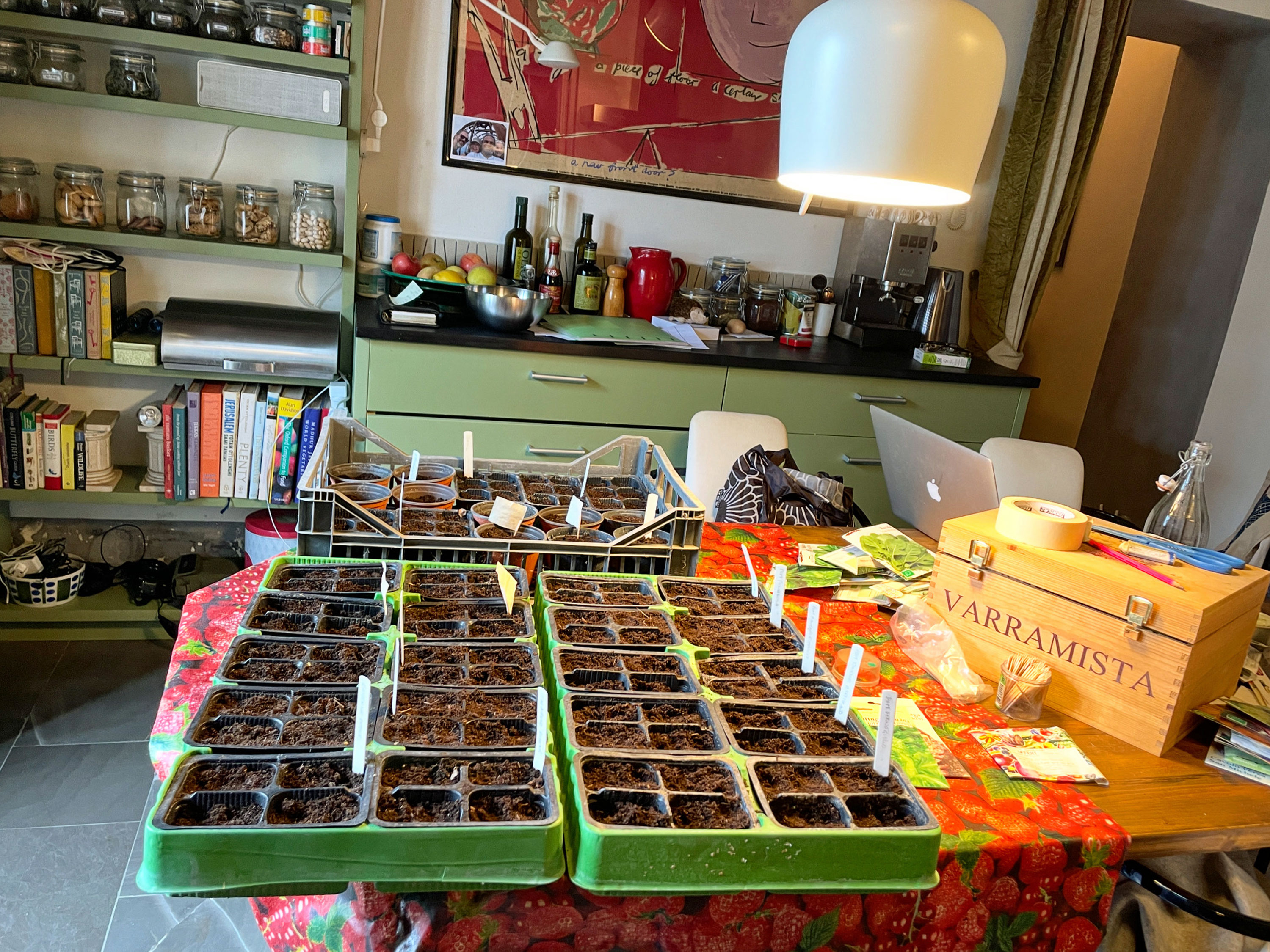
I came back from Berlin to find my horrid little plastic greenhouse torn to shreds by the wind, and my seed trays and pots of cuttings buried deep. I have brought them all inside, and am trying to thaw them out. But the seed pockets I can squeeze are hard as rock, which makes me suspect that the compost is frozen quite solid in all of them. Have I just lost all my summer crops? I shall keep them in the living room now. I’ve set up the shelves from the terrace outside our bedroom by the south-facing window in the living room (leaving, obviously, an escape route for me to climb out of if the front door doesn’t open): it’s not warm in there but at least they should have sufficient light by that window.  My poor plants.


It snowed all night and most of the day today. I am beseiged. Each leg sinks into the fluffy snow half way up my thigh: you begin to feel that the next one may not follow. I had to shovel my way up to the chicken house to get more wood. That was after I shouldered hard to get the front shutters open just a tiny crack then had to apply the shovel through that crack in order to get any further.

I’m besieged, too, by birds. There was nowhere protected to put out water and seeds and bread so I left them sitting on the step right outside the kitchen. Two tits and a robin spent most of the day flitting between olive tree and food. The squabbled at times over who had precedence. But mostly they just flitted. And sat out there, peering at me in almost dog-like fashion. Nothing I did fazed them.  My cellphone – my umbilical cord to the outside world – sat by the window and rang and buzzed, I answered it and chatted, and they carried on as if I were nothing more than a minor inconvenience.  So pretty. And, as C texted to me from Cambridge, someone to keep me company in my isolation.

But there was another one too, one that was causing me immense anguish as it beat itself wildly against the inside of the chimney in the living room. The flue was closed, so it couldn’t get out into the house and I was in some ways pleased about that: I love birds sitting outside the window looking at me devotedly but when they start flapping about me, my bird phobia comes out. Still, as this creature – I was hoping it was nothing less savoury than a bird – had started making its din late at night, I could only imagine it was an owl. And the last thing I wanted was to have the death of an owl on my conscience. For Italians, they’re birds of ill-omen; for me, they’re great sweeping creatures who confer intelligence on the night. I decided to leave it just long enough for it to wear itself out, but not long enough for it to perish. Then I would save it. There was no sound coming from the flue when I got back after lunch from my walk to town. But still I couldn’t, quite. So I called my friend S who said, in her marvellously Wodehouse way, “gosh Anne, it’s at times like this that a girl needs a man.” That was it. How could I not rise to a challenge like that? I placed a big plastic box beneath the flue opening and was ready to pull the chain to open it with one hand, and slap the lid on the box with the other. But the lovely creature – a tiny brown owl – tumbled out a little sleepily nowhere near my box, did a couple of slightly stunned turns around the room, then flew obligingly out of the open window. I had the definite feeling that he (or she) too had decided to stop struggling and wait for me to set things to rights in the avian world. It was a good feeling.

Posted in MUSINGS FROM UMBRIA | Tagged , , | Leave a comment

2 February 2012

  For a while, electric light seems uncannily bright when you’ve been without power for more than 36 penumbrous hours. It makes you understand one important reason why the original inhabitants had the living quarters in the upstairs part of these old houses (the other reason being that the heat from the animals stabled below rose, in theory, into the dwelling above, though in fact I think there may have been more cockroaches rising than warmth). For all the extra windows and french doors we added, it’s never as bright down here as it is upstairs.

But your eyes begin to grow accustomed to the murk. Actually, I say that but that’s probably just my romantic Little House on the Prairie reveries kicking in. As C pointed out, be as deep in snow as you want – and we’ve got about 35cm with more forecast for tonight – but you can’t channel the spirit of Laura Ingalls Wilder when your pantry’s full, your wood stove is burning brightly and you’re not living in a house where snow blows through the cracks in the walls. She has a point.

The snow fell overnight between Tuesday and Wednesday, when we woke up to a greater depth of the stuff than we’ve ever seen here before. Admittedly we were away for the great storm of March 2010, when 50cm fell in the space of a couple of hours. That, we were told, was wet sludgy rain which ripped huge branches off trees and deposited them all over the roads. This, on the other hand, is beautiful, powdery sugar-snow: the kind you’d love in a ski resort.

I had parked the car up in the top car park so we wouldn’t be trapped by the slope-plus-twist of the bottom one, but my preparations were inadequate for the situation and our car is now stranded at a jaunty angle, its tail end very close to my roses (poor things). As Lee attempted to exit, one chain disintegrated beneath the spinning wheel.

So off we trudged on foot, our computers in our rucksacks, up to town and the warm Café degli Artisti with its coffee and cornetti and wifi and civilisation.

It has been two days of such vindication for L.

First of all, his insistence that we live within walking distance of a coffee: that was his ne plus ultra criterion when we were buying a house in the country. Well wrapped up and setting a brisk, warming pace, it was almost pleasurable to tramp through the snow to town.

And secondly, his Transporter. I poured cold water on his funny little motorised glorified wheelbarrow with caterpillar tracks when he insisted on having it for his birthday last year. And often since I have wondered whether it was worth the great expense. But it has become our essential snowmobile now, flattening tracks for the car to pass over (except the car didn’t want to oblige) and, more importantly, hauling C’s huge suitcase up to the centre this morning, to a point where a taxi could pick her up and take her down to Chiusi to get the train to Rome and her flight to the UK. It’s a noisy contraption, and certainly gets itself noticed. But the stares all the way up to town were (I think) of admiration and if sales of Transporters go up around here over the next few days, it’s all due to L’s shiny red example.

It has also been two days (for me at least) of thinking of the future – not the future that we hope for, but a possible future in which weather patterns go crazy and we find ourselves having to deal with a whole new set of circumstances. In fact, a whole old set of circumstances.

When I mentioned at the supermarket checkout this morning that we had no power, the line was furious on my behalf. “Only in Italy,” harrumphed Marcello on the till. (I assured him that whenever a few flakes fell in England, everything went haywire, and much more so than here.) But I wasn’t furious. Maybe it’s the puritan in me, or just another of my far-fetched ideas. But I see it as training.

Here we are in our comfortable house, where the windows and doors fit and there are no draughts, where we’re well stocked with candles (for atmosphere, not light obviously) and where water continues to run when you turn the tap on. Yet there are still people up the road who, in living memory, had none of those things and thought it normal. Hiccups like this just reinforce my feeling that we’re living in a remarkable bubble of self-delusion. A bubble where we accept all kinds of things as normal which are quite abnormal.

The most obvious for me is the way we all eat food produced using God-knows-what by God-knows-whom – great faceless multinationals who don’t care about us but who have convinced us to buy from them rather than use the land and food heritage we have, depriving us in the space of just a few decades of any sense of responsibility for our alimentary well being. But I shouldn’t get started on that. We depend on power companies for light and heat: this is fine, they’re on our side (if only because they need us to make money). But what if they weren’t? What if someone else offered them more money than us? (I’m thinking here of the Chinese investing in the UK water supply.) But that’s way ahead – or least I hope so. For the time being, here we are in our valley at the end of a long and vulnerable bit of electrical wire. Why don’t we have any lamps and a bit of oil to hand? So simple, so efficient. The only ones I could find had rusted/rotted out at the barbeque and the wicks had corroded away. So we coped with a house full of candles. Very romantic. But not very good for coping ‘without’.

****

Up in town, everyone has pulled out their ski gear to stand in gaudily coloured huddles and moan about the weather. But aside from – in true Italian fashion – having the right outfits, they don’t know how to enjoy the meteorological conditions. The only kids I’ve seen having fun in the snow are Sri Lankan; Italian mothers are, no doubt, tetchily keeping their offspring inside with dry feet. The only sledge I’ve seen out – apart from ours of course – belonged to the boy who lives at the end of the other fork of our track, a 17-year-old with a French mother and therefore less hemmed in by convention. One snowman, on a table outside the Café degli Artisti. A couple of half-baked snowballs thrown by a tiny tot at his slightly larger sister, resulting in a shrill telling-off from his mother. Snow does nothing for me – I like heat, and hate that slipping sliding feeling under foot – but even I can see that this is wonderful snow, absolutely made to be played in. It makes me sad to see that it’s not being used as it should be.

And what of here? Well, all my plants are buried beneath gentle white mounds. I had begun the long slow job of pruning the other day. My rugosa roses up the top were looking so beautifully neat. Already they were worrying me though: I’d never had to cut out so much dead wood, and I was wondering whether this was just their age, or the drought conditions they had been struggling through for the last couple of months. They’ll get their water now: lots of it. But will they emerge alive from their shroud?

I was so proud of my fleece-and-canes covers for my little broad beans and struggling fennel, which had withstood near-hurricanes; but they cracked and collapsed under half a metre of snow, though the plants below, after I had dug them out, were remarkably unscathed, with the fleece still covering most of them. I have reconstructed something less ambitious over the broadbeans and spinach, and pulled up all the fennel which was looking unhappy anyway. I’m now cooking it to freeze. And I tucked my baby cabbages back under a bit of fleece, in the hope that they’ll pull through.

I’ve shaken snow out of fruit trees and olive trees, and tied a messy old bit of tarp over my orange-laden orange tree. Huge branches have cracked off the lovely field maple at the south end of the house, which is odd because there’s really no reason why that should happen. I hope the rest of the tree will be all right. A couple of the fallen branches are resting on my newly planted bank along there, but I have done nothing to move them for fear of disturbing the roses and cornus underneath. They’re tough those plants, and I put great mounds of mulch around them just the other day. Fingers crossed.

Since we woke up on Wednesday, power-less and with no hot water, our wood-burning stove (and of course the fact that we have a gas cooker) has been our salvation. We spent much of Wednesday trying to get through to the power company, ENEL. But we’d go through the recorded instructions, punching the  appropriate buttons and and waiting and waiting, only to be cut off just when it sounded like we were about to be attended to. So we gave up, and decided to wait until all the old bids, who were presumably calling in in their thousands, had gone to bed. We lit candles and played Scrabble and washed up with kettle-boiled water and a torch hanging over the sink. C even washed her hair, kneeling surrounded by candles in the middle of the kitchen floor. Just before midnight, we got through. The daytime wait had been infuriating. But they offered to send someone round then and there. We told them we were going to bed and not to bother. When the boys turned up this morning, they said they had been out until 3.30am and back at work again at 7am. After a 6am start on Wednesday. You have to hand it to them, once they know you’re in trouble, they react pretty rapidly and effectively.

They tried to get a big council bulldozer to clear the road down to us so they could get their equipment to the last pole, where the line had come down. We stopped that very quickly when we saw the dog’s dinner they’d made of the lane with a smaller machine as far as Mario’s: all the top has been scraped off – when the thaw sets in, the road is going to wash away. Very kind of them and all that, but that will already be an expensive mend; we dreaded to think of the flood coming down a misshapen, top-less track to us without the necessary cuts to channel the water off into the fields. So they scrambled down the hill from J&ML’s, across the valley, somehow manoevring their equipment through fallen trees and hidden brambles. And patched us up.

They’re saying to expect ten days of this. I’m wondering whether the woodpile will last. Mind you, we’re off to Berlin next week (if we can get there, of course) so that will help to eek it out. But will it last until L gets back? I’m only going for a couple of days. He’s staying two weeks. Will I once again find myself stacking 20 quintals of wood, all by myself? I do hope not.

Now all that remains to do is to get the phone line up and working again.


Posted in MUSINGS FROM UMBRIA | Tagged | Leave a comment

Chickpea & turnip top soup

Whenever – and it’s a regular event I’m afraid – I look up at the clock, expecting it to be 11.30am and finding it’s 1.30pm already, I whip up some very simple soup, often involving jars of ready-cooked pulses.

This 20-minute wonder is just what you need on a cold winter’s day when you’re hungry and in a hurry. I use cime di rapa – turnip tops – which are produced in abundance on the flat loamy shores of Lake Trasimeno: I love its mustardy aftertaste. I rarely see the turnips themselves on sale – I think they’re considered fit only for pigs – but the leaves are a regular feature on local plates and the fields left, for one reason or another, unharvested by farmers produce flowers which cut immense swathes of acid yellow through the landscape, glowing in a too-bright-to-be-real way when caught by the setting sun. Having said this, for the sake of this soup, any kind of leaf vegetable, from kale to cabbage, will do.

Chickpeas – 300 g soaked & cooked
Potatoes – 2 medium
Turnip tops (cime di rapa) – 300 g
Onion – 1 large
Garlic – 2 cloves
Chilli – small piece, optional
Vegetable stock
Olive oil

Peel the onion and garlic and chop them coarsely, then drop them into a saucepan in which you’ve heated a couple of tablespoons of olive oil. Put the chilli in too at this point, if you’re using it.

In the mean time, prepare and wash your greens and put them in a large saucepan to steam.

When the onions are going soft, add the peeled and chopped potato – the smaller the pieces, the quicker they will cook – and half of the chickpeas which should have been strained and rinsed. Toss them with the garlic and onion for a minute or so, then pour in 1.25 litres of boiling water or stock (if you use stock cubes, add one now). With the saucepan covered, bring this to the boil, and leave it bubbling hard until the potatoes are soft – about five-ten minutes, depending on your potatoes. When they’re ready, remove the chilli and blitz the soup with a stick blender until it’s smooth.

When the turnip tops are cooked, chop them a little and add them to the soup, along with the remaining chickpeas. At this point you’ll need to add more liquid: gradually pour in the water you used to steam the vegetables, adding enough to get a consistency which is nice and creamy without being too runny or too gluggy.

Cook for another couple of minutes, to get the flavours to blend nicely, and serve the soup with a sprinkle of grated parmesan cheese.

© Anne Hanley, 2012

Posted in MY UMBRIAN KITCHEN | Tagged , , , | Leave a comment

23 January 2012


On Saturday afternoon we cycled around the northern and eastern shores of Lago di Chiusi. It’s a strange and wonderful landscape over there: intensely agricultural with huge freshly tilled fields rolling up swelling hills away from the lake. Here and there on the slopes are isolated casali, huge rectangular structures in stone or – more often – in brick, still with a purposeful air depite being, as often as not, abandoned.

Elsewhere, and especially in the villages around the lake (Porto, Vaiano, Gallina), are some of the worst abominations ever to mar such glorious countryside, structures of such gross banality that they make me want to cry. Cry not just because of their ugliness, but also because I can’t imagine the kind of lack of sensitivity which makes it possible for anyone to live with such dreadfulness against such a breath-taking backdrop… never mind the idea that someone – heaven help us – designed such buildings or had them constructed. How can anyone be so blind?

I don’t intend this as an intellectual-snob diatribe. I truly weep for anyone at all who can be so utterly unmoved by what’s around them that they would blight it in that way.

Just above where we parked the car, on the eastern shore of the lake, one of those immense casali stood half-way up a field, its roof caving in and stumpy, twisted trees growing through its walls. Next to it stood a stark, brick farm building: tall, windowless and with dozens of square chimneys ranged along its roof. I took it for a tobacco-drying shed, but the name of the property, our map told us, was La Saponaria – the soap factory: just a name, or really its original function? Slightly higher up, and clearly on the same property, a squat, unappealing modern house clad in nasty stone imported from somewhere else with tacky arches out front, surrounded by those Cupressus arizonica which were so popular as windbreaks in the 1970s and which have nothing to do with the local flora.

How anyone could bring themselves to abandon the elegant casale for this nasty modern bunker, who knows. All right, the family probably rubbed their swollen chilblains through many winters in the draughty, icy casale with no running water and no power supply. In which case the local planning authorities should have stepped in to point out that that situation could be remedied. Then again, in the 1970s and even ‘80s, the local planners probably came from much the same background and understood the yen for something boxy and modern where the bathroom was inside, and heat and light appeared magically at the flick of a switch. It would be comforting to think that things have changed now and that the same mistakes won’t be repeated. But they haven’t and they are. It makes me so sad.

All of which makes it sound like our burst of peddling energy was a nightmare trip. It wasn’t. Look away from the abominations and there was that magical countryside in all its glory, presenting us, as the afternoon drew on, with one of the most dramatic sunsets I have seen for a long, long time: pale apricot splashes across the sky swiftly turned to vermillion and puce and purple and deep deep orange, all perfectly reflected in the perfectly silky lake.

We stood on a little beach, not even noticing the thick dew falling, quite breathless and speechless.

Saturday morning, on the other hand, I spent at San Giuseppe. The occasion was a seminar on future trends, the first in a series of events to mark the publishing house’s 250th anniversary. The talks (well, some of them) were thought-provoking; the topic itself fascinating. But most satisfying of all was, on that beautiful morning, seeing people out in our garden: wandering, admiring, commenting… just being there. Mauro the gardener had the whole place looking immaculate. Despite its size and the formal lay-out (in places), it’s a comfortable garden and the people moseying about looked like they were finding it very easy to be in. So gratifying.

Fernanda died last Friday. Poor old thing: she had been bed-ridden up in that ugly house up the lane for years. People in town were surprised when they heard she was still alive. She was always quite dotty, becoming rapidly more so by the time we got here. She seemed wondrously bemused when we bought this, the house she grew up in. “I always hated that house,” she told me with a grin soon after we bought it. Thank you Fernanda. And I can still wonder at the horrors around the lake when I have benefited personally from the local inability to comprehend the potential beauty of these old ruins…

Posted in MUSINGS FROM UMBRIA | Tagged , , , | Leave a comment

Apple & quince crumble

Even at this time of the year, I have quinces sitting about. Having eaten and/or discarded any with imperfections, I find that months later, despite having been left, forgotten, in a bowl in the corner of my rather warm kitchen, some quinces remain, unwrinkled and beautifully perfumed.

Quinces alone make for a rather daunting compote: their rough-celled texture – like pear except more so – can grate hard against your teeth. But mixed with some strong-flavoured cooking apple – here we use renette, pippins – it is delicious. Top this off with a chewy crumble mix and you have a fantastic dessert.

Of course, quinces aren’t an essential ingredient here – just one that rings the changes. This crumble topping goes perfectly with any stewed fruit you want, including plain apples. I prefer my fruit desserts to taste of fruit rather than sugar, so have added none to the stewed fruit. If your tooth is sweeter than mine, you’ll have to adjust this to suit your own tastes.

Cooking apples – 2 large
Quinces – 2 medium
Spelt flour – 100 g
Oat flakes – 100 g
Ground almonds – 50 g
Butter – 120 g
Sugar – 80 g
Powered ginger
Cinnamon
Cloves
Fruit juice – as necessary

Peel the apples and quinces. Core both and chop them, the apple coarsely and the quince quite finely as it tends to break down less than the apple. Put them in a saucepan with a shake of ginger, another of cinnamon, four or five cloves and enough fruit juice (freshly squeeze orange juice is extra good) to cover the bottom of the saucepan to a depth of about half a centimetre. Cook the apples slowly, covered, over a low heat, until the fruit is soft. You may need to add more fruit juice if the fruit seems to be drying out.

Set the oven to 180°C.

Spread the oats on a shallow tray and bake them for five or ten minutes, until they’re dry and hard. You now want to mill them in such a way that you have something which is more pulverized oats than oat flour. I use a grain mill on a coarse setting. But a quick whizz in a blender should do the trick too.

Mix the oats, flour and ground almonds in a bowl, and rub in almost all of the butter. Obviously, this can be done in your mixer if you don’t feel like rubbing in by hand. Now add all but a tablespoon or so of the sugar, and mix that in.

Spread the fruit in a ceramic pie dish, about 15-20 cm: smaller if you want a thicker crumble, larger if you prefer it more thinly spread. The fruit should be nice and moist but if there’s a lot of juice sloshing around on top, spoon some off: too much will turn your crumble mushy. Now spread the crumble over the fruit, dot the top with small lumps of the remaining crumble and sprinkle the remaining sugar evenly across the crumble.

Serve the crumble hot with whatever takes your fancy: cream, custard or vanilla ice cream. I so love the taste of the fruit and the texture of the oaty crumble that I usually have it just as it is.

© Anne Hanley, 2012

Posted in MY UMBRIAN KITCHEN | Tagged , , , | Leave a comment

Celeriac & cauliflower soup

I’m no fan of celery but I do like the sweetish, earthy flavour of its relation celeriac, a knobbly-looking root which is in fact a hypocotyl – the below-ground stem of a leaf – and not a root at all, giving it the advantage over most roots that it is not at all starchy. Some people like the grated or thinly sliced flesh of celeriac in salads, but personally, I find the taste of it raw rather sickly. Cut into pieces, steamed, and treated much as mashed potato, it’s very good – and far lighter than mash. In soup it’s excellent.

Celeriac – 1, about 12-15 cm in diametre
Onion – 1 large
Potato – 1 medium
Cauliflower – half of one medium
Garlic – 2 cloves
Cumin – 1 tsp
Curry powder – 1 heaped tsp
Fresh ginger – 2 cm cube
Parsley – small sprig
Vegetable stock or stock cube
Olive oil

Peel and chop the onions and garlic. Peel the ginger; if you like ginger and plan to leave it in the finished soup, chop it; if not, leave it in one or two largish lumps which can be fished out easily.

Heat a couple of tablespoons of oil in a heavy-bottomed saucepan and gently fry the onions, garlic and ginger, together with the cumin and curry powder. I’m being a bit generic here: you could use garam masala or any curry powder mix you fancy, or you could whizz up your own blend of spices – it depends on what you like. The quantity, however, is so small that it isn’t going to have a huge influence on the finished soup – it just gives it a hint of spiciness.

Cut the hard outside off the celeriac and chop the flesh into small cubes. Peel and chop the potato. Add these to the onions etc in the saucepan, and just cover everything with water or vegetable stock. Bring it to the boil and let it simmer gently, covered, until the vegetables are soft. If you’re using stock cube, add it to the bubbling mixture. If the water/stock seems to be drying up, add enough to keep the vegetables more or less covered.

While the vegetables are simmering, break half a cauliflower into very small florets and rinse them.

Twenty minutes should be enough to soften the celeriac and potato. Take it off the heat and, with a stick blender, blitz the ingredients in the saucpan until they are smooth. Hot bits may fly, so be very careful how you do this. And don’t forget to fish out the ginger pieces if you don’t want them in there. You’ll probably find that what you have in the saucepan now is thick enough to stand a spoon up in – more mash than soup. Add enough water/stock to make it into a thick liquid, add the cauliflower florets, and put the pot back on a low heat, uncovered, to carry on simmering for a further 15 minutes, or long enough to cook the cauliflower through.

Serve this soup with a drizzle of very good oil, lots of freshly ground black pepper and a sprinkling of finely-chopped parsley.

© Anne Hanley, 2012

Posted in MY UMBRIAN KITCHEN | Tagged , , | Leave a comment